How to present so people buy your idea: 5 lessons from Patrick Winston
Patrick Winston taught the same talk on how to speak for 30 years at MIT. I rewatched it while preparing a masterclass and something hit me that I'd missed every time before.
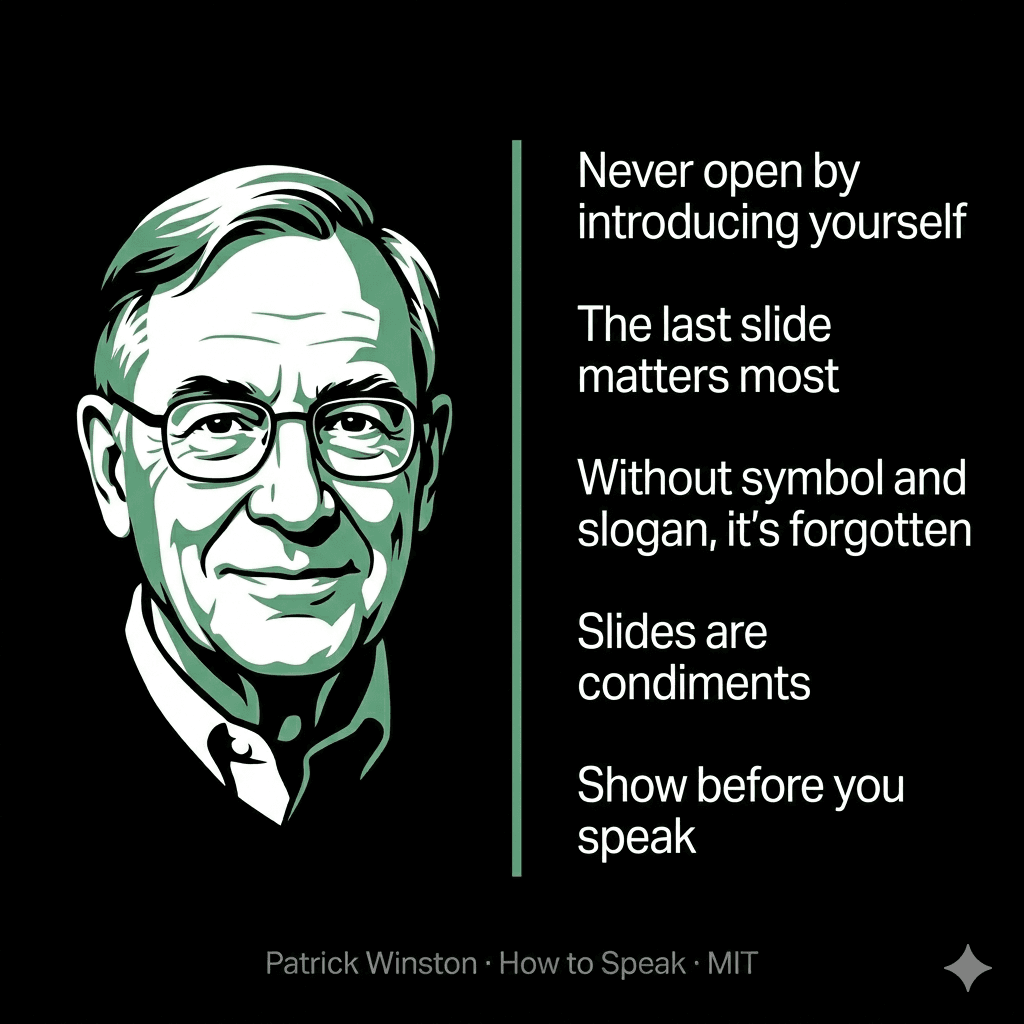
By the end of this you'll have five concrete things to change about how you present — so your audience doesn't just hear you, they buy the idea.
Week 3 of 5.
Patrick Winston was a professor at MIT. His specialty was artificial intelligence. But the class everyone remembers had nothing to do with that. It was about how to speak. He taught it for 30 years straight. He died in 2019 and people still watch it like it's new.
I rewatched it while preparing a masterclass for design students at the Universidad de Chile on May 7th. And something hit me that I'd missed in every previous viewing.
Picture this. A designer spends three weeks on a proposal. The solution is brilliant — it solves exactly what the client needed. They walk into the meeting, open their laptop, and two minutes in the client is looking at their phone. Not because the solution is bad. But because they opened by introducing themselves, walking through their process, thanking everyone for their time. The meeting ended with nothing decided. The client will "think about it."
This doesn't only happen to designers. It happens to anyone with something valuable to show who doesn't know how to open. Winston had a name for it. He called it a crime.
These are the five that hit me hardest.
Never open with who you are or a joke
When you walk in to present, the audience is asking one question: is this worth my attention? They don't know yet. They're calibrating. And at that moment, telling them who you are or opening with a joke doesn't answer that question — it delays it. The promise has to come first: this is what you'll know by the end that you didn't know at the start. Once the audience has decided it's worth staying, then it makes sense to introduce yourself. Because now they care who you are. The other way around almost never works.
The last slide matters more than the first
Memory doesn't work linearly. What we remember most from any experience is the end. That's how we're wired. So ending with "any questions?" or "thank you so much" is literally wasting the moment when your audience is most primed to retain what's about to stick. Winston said the last slide should be your contributions: what the audience knows now that they didn't before. Not a summary. Not an emotional close. A concrete list of what they're taking with them. It's the only thing they'll repeat when someone asks what the presentation was about.
An idea without a symbol, slogan, and surprise is forgotten before you finish speaking
The brain doesn't store information — it stores structures. An idea without a concrete form to be remembered in simply won't be remembered. The symbol is the object or image that represents the idea visually. The slogan is the short phrase someone can repeat tomorrow without having to explain it. The surprise is the counterintuitive truth that challenges what the audience already believed. Without these three, your idea can be brilliant and disappear anyway. With them, mediocre ideas survive decades.
Slides are seasoning, not the dish
Winston had a very specific argument for this. The human brain can't read and listen at the same time. They use the same cognitive channel. So when there's text on the screen and the presenter is talking, the audience does one of two things: reads the slide and ignores the presenter, or listens to the presenter and ignores the slide. Either way, one of them is redundant. That's why reading aloud what's written on screen is the worst possible crime — not because it's boring, but because it's redundant. You're competing against yourself. Slides should only carry what can't be said with your voice: images, diagrams, key numbers. Everything else goes in your mouth.
What you can touch is understood. What you can only read is forgotten
Words describe. Objects demonstrate. And the brain trusts what it can see and touch far more than what it has to imagine. Winston brought physical objects to his classes — something concrete to put in front of the audience and make tangible what would otherwise be abstract. A real object tells the audience something no slide can: this isn't theory, this exists. In design that something concrete is the prototype. In a business meeting it's the real number on the table. In a class it's the live exercise. Winston and agile methodology arrive at exactly the same place from different directions: show something before you start talking.
I took these five lessons and built a library of prompts to use with Claude or ChatGPT before any presentation. I'm using them myself to prepare the May 7th class.
If you want them, message me on WhatsApp — I'll send them directly: https://wa.me/56992193607
See you next week. 3/5
Simón Espínola
Economist · Strategist · Builder
I work with founders and companies that want to grow with structure. If this resonated, let's talk.
Related posts
Subscribe
Essays every two weeks. No spam.