Down the rabbit hole: which AI tools actually work for designers today
Week 4 of 5. I went deep researching which AI tools genuinely help designers prototype fast. What I found changed how I'm structuring the class.
Hey everyone, week 4 of 5.
This week I went deep — proper rabbit hole territory — and I don't regret it.
We're building a masterclass in public for design students at Universidad de Chile. The core premise is simple: Scrum + Kanban + AI let you show the client something before they even know what they want.
But to teach that, I first had to answer a very practical question: which tools actually exist today that genuinely help a designer prototype fast?
I went to find out. What I found changed how I'm structuring the class.
The ecosystem has exploded. We're not talking about generating a pretty image with a prompt anymore. Today you can animate products, prototype full interfaces, and model physical objects — all in an afternoon. Most tools have a free plan to explore, but if you want genuinely good results, you'll need to pay. The good news: prices are reasonable and easily shared across classmates.
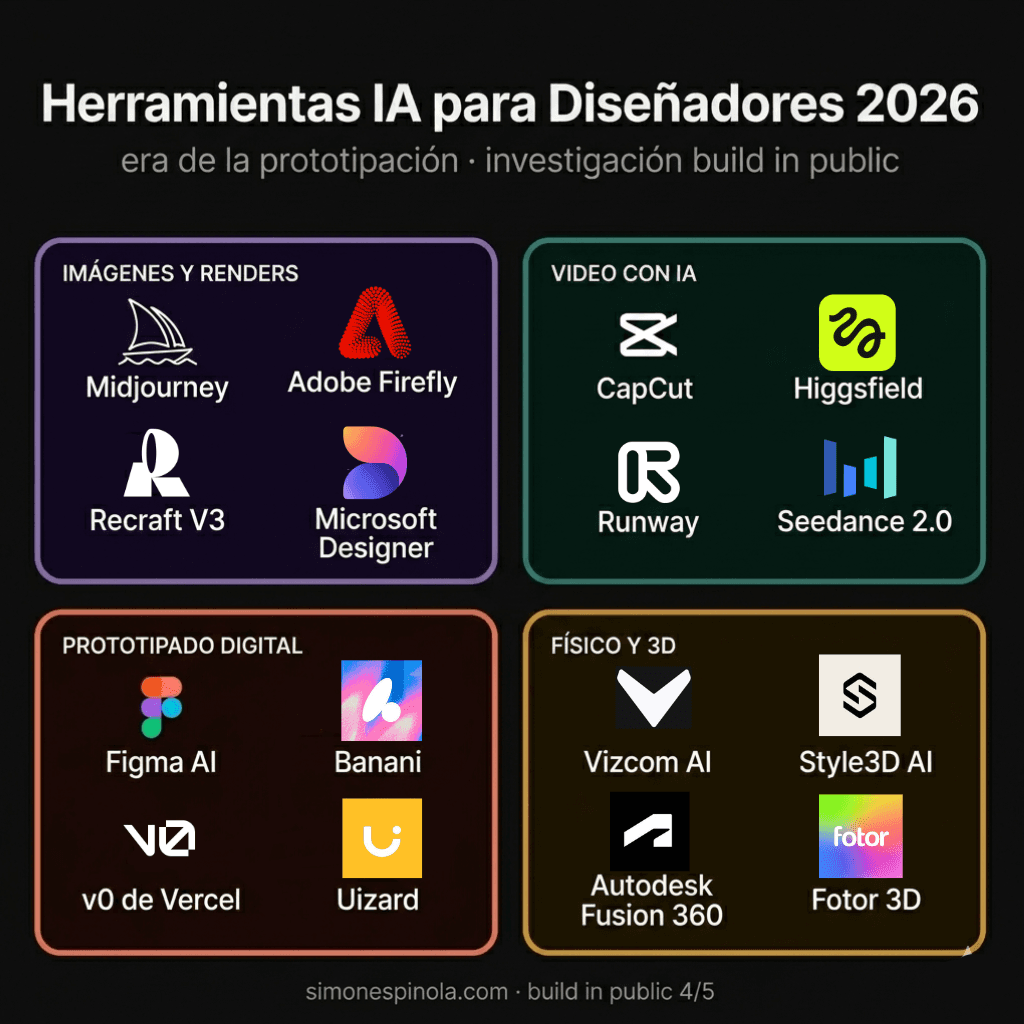
I organized everything into four categories for the class.
Images and renders
Midjourney is still king. No tool beats it on aesthetic quality. If you need to show a client a visual concept before building anything, Midjourney is the answer. Adobe Firefly is the safe choice for corporate projects where copyright matters. And Recraft V3 is the most interesting for graphic designers: it converts raster to editable vectors and is exceptional for icons and logos.
AI video
This is the most exciting category right now, and the most relevant for the prototyping era.
Seedance 2.0, ByteDance's model, is probably the biggest advance in video generation of the past few months. Text, images, reference video, audio — all in a single generation.
What nobody tells you: you don't need to go directly to Seedance. CapCut already integrated it. You have the most advanced model on the market in an interface anyone can use in ten minutes. Free, with weekly credits. If you want more cinematic control, Higgsfield is where professionals work with the same model but with director-level tools.
In agile terms, this changes everything. The prototyping sprint that used to take days now takes hours. The client sees something real before the conversation gets lost in words.
Digital prototyping
Figma is still the standard and already has AI built in. But the most impressive tool right now is Banani: describe what you want, it generates five variations, exports to Figma and code. In hours you have something to show at your next sprint review. Vercel's v0 goes one step further and generates actual working code, which is a whole separate conversation.
Physical products, merch, and 3D
This is the earliest part of the ecosystem, but there are already interesting things. Vizcom AI converts sketches into 3D renders, built specifically for industrial design. Style3D AI specializes in fashion and textiles. For fabricating real objects, Autodesk Fusion 360 is still the most powerful, though it has the steepest learning curve.
My recommendation if you can only learn one tool this week
CapCut. Not because it's the most powerful. But because it's the most accessible, it already integrated the most advanced model on the market, and in ten minutes you can be generating product video that six months ago required a full production team.
In an agile methodology, prototyping speed is your competitive advantage. CapCut gives you that from day one, with no learning curve.
But there are two things you need to know before using it for real work.
First, the free plan is enough to learn and explore, not to produce consistently. The Pro plan is $7.99 a month — reasonable, and easily shared among classmates or a team.
Aviso importante
For exploring, learning, and prototyping your own ideas, it's unbeatable. For professional client work, use it with judgment.
The barrier was never technical. It was how long it took you to show someone something real.
See you next week. 4/5.
Simón Espínola
Economist · Strategist · Builder
I work with founders and companies that want to grow with structure. If this resonated, let's talk.
Related posts
Subscribe
Essays every two weeks. No spam.